

Introduction
Hyderabad forest news dominated national headlines in early 2025 after the Telangana government cleared over 400 acres of protected green land near the University of Hyderabad overnight. This article covers everything from the first bulldozer to the Supreme Court order and the current restoration plan, so you have a complete, fact-based picture of what happened and what comes next.
Quick Answer: Hyderabad forest news in 2025 centers on the Kancha Gachibowli forest, where the Telangana government cleared over 400 trees in late March to build an IT park. The Supreme Court halted all tree-felling on April 3, 2025, ordered a same-day site inspection, and as of August 2025, the state is preparing a court-supervised restoration plan.
What Is the Kancha Gachibowli Forest?
Kancha Gachibowli is the forest at the heart of all recent Hyderabad forest news. It sits in western Hyderabad, close to the University of Hyderabad campus in Telangana. The site covers roughly 400 acres of naturally grown Deccan scrub forest, complete with a natural lake, granite rock formations, and dense native tree cover.
The state government classified this land as “revenue land,” not forest land. That classification removed legal protections under the Forest Conservation Act and allowed development to proceed without the usual approvals.
The forest lowers ambient temperatures in surrounding neighborhoods by an estimated 1 to 2 degrees Celsius and recharges local groundwater. It also supports eight species of scheduled animals under India’s Wildlife Protection Act, including peacocks and spotted deer.
Why the Hyderabad Forest Was Cleared
The Telangana government cleared the Kancha Gachibowli forest to develop a large IT park. Officials projected Rs 50,000 crore in investment and roughly five lakh jobs from the project.
A land dispute between the University of Hyderabad and the state concluded in May 2024, handing land rights to the government. Within months, preparation for clearing began. No Environmental Impact Assessment was conducted before a single tree fell. This became the central legal failure the Supreme Court later focused on.
By classifying the land as revenue land rather than forest land, the government bypassed mandatory expert committee surveys required under the Forest Conservation Act. This is the same loophole that makes Hyderabad forest news a recurring pattern, not a one-time event.
When Did the Tree-Felling Start?
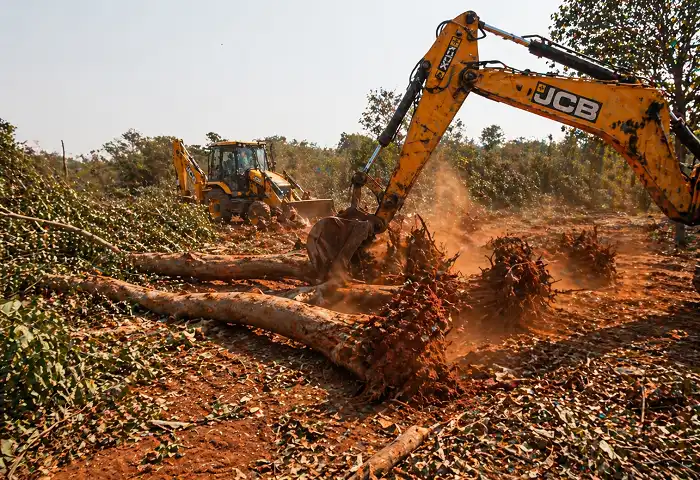
Tree-felling at Kancha Gachibowli began on March 30, 2025, coinciding with a long weekend and the festivals of Ugadi and Gudi Padwa. The timing raised immediate suspicions that the government chose a holiday period to avoid media attention and judicial oversight. Law.asia
Satellite images from March 28 and April 2 show rapid clearing of forested land within just a few days. Over 400 trees were felled during this period. India TV News
Videos of peacocks crying as bulldozers moved through the forest went viral across social media platforms. Spotted deer were reported injured near the campus. Students from the University of Hyderabad launched protests at the site within hours of the clearing becoming public.
The Vata Foundation and activist Kalapala Babu Rao filed writ petitions in the Telangana High Court. The high court ordered a halt to all development at the site. That same day, April 3, the Supreme Court stepped in.
How the Supreme Court Responded to Hyderabad Forest News
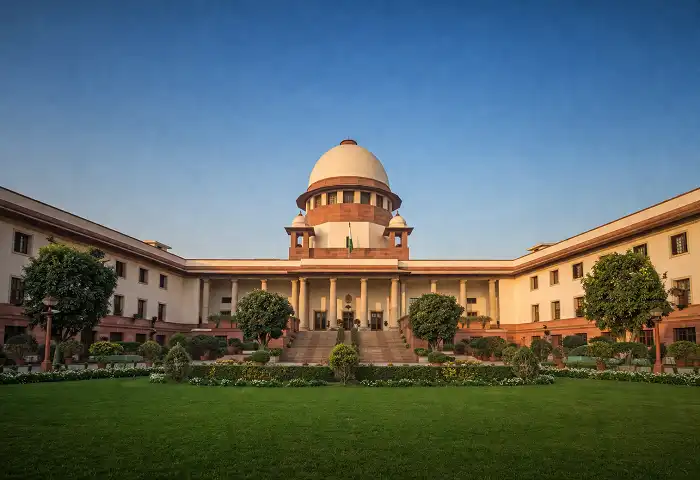
The Supreme Court took suo motu cognisance of the Hyderabad forest situation on April 3, 2025. A bench of Justice B.R. Gavai and Justice Augustine George Masih noted that authorities appeared to have rushed tree-felling by exploiting a long holiday weekend. The court also noted the forest is home to eight species of scheduled animals. SCI
The bench directed the Registrar (Judicial) of the Telangana High Court to visit the Kancha Gachibowli site immediately and submit an interim report by 3:30 PM that same day. It ordered the Chief Secretary of Telangana to stop all tree-felling until further orders.
The Registrar’s site visit confirmed the presence of a natural lake and significant vegetation. This report supported what activists already documented on the ground.
The Supreme Court had previously issued orders on November 30, 2023, February 19, 2024, and February 3, 2025, barring governments from reducing forest land without providing compensatory land. Telangana formed its expert committee on March 15, 2025, just two weeks before the incident began. No mandatory surveys under Rule 16(1) were completed before clearing started. Law.asia
The court also asked what happened to the timber from the felled trees, raising accountability concerns that remain part of the ongoing case.
Wildlife Affected by Hyderabad Forest News Events
Eight scheduled animal species live inside Kancha Gachibowli. The Hyderabad forest news coverage gave many people their first awareness of wildlife this close to a major Indian city center.
Peacocks were most visible during the clearing. Their distress calls, captured on video, became the defining image of this crisis. Spotted deer were found injured near the university campus in the days following the bulldozing. Reptiles, insects, and bird species native to Deccan rocky scrub habitat also lost significant cover.
Deccan rocky scrub is a globally threatened ecosystem type that takes decades to regenerate even under ideal conditions. Once an IT park sits on this land, no restoration plan brings the original habitat back.
The Bigger Pattern Behind Hyderabad Forest News
Since 2014, Telangana has lost over 11,422 hectares of forest land. Global Forest Watch recorded 1,590 hectares of tree cover loss in the state in 2020 alone. The Environmental Blog
The Kancha Gachibowli case is not isolated. The Hyderabad forest news cycle repeats because the revenue land classification system gives the state a consistent method to avoid forest protection laws. Forested areas get labeled as administrative land, development moves in, and by the time legal challenges reach courts, much of the damage is done.
Urban ecologists warn that continued forest loss intensifies Hyderabad’s urban heat island effect, reduces monsoon water absorption, and raises flood risk in low-lying areas. The Kancha Gachibowli forest alone cooled surrounding residential and academic neighborhoods. That cooling function is now gone.
You can track broader India environmental policy developments to see how national decisions shape state-level outcomes like this.
What the Government Offered After the Hyderabad Forest Crisis
After protests and the Supreme Court order, the Telangana government proposed a 2,000-acre eco-park at a separate location as compensation for the Kancha Gachibowli loss.
Environmental experts rejected this as a meaningful solution. A planted eco-park and a mature natural forest are ecologically different things. The hydrological function, biodiversity, and microclimate regulation of an old-growth Deccan forest cannot be replicated by landscaping a new site kilometers away. Neighborhoods that lost Kancha Gachibowli gain nothing from an eco-park built elsewhere.
Urban planners made the same point: the climate benefit of a forest is location-specific. Moving it defeats the purpose.
How Students and Activists Shaped Hyderabad Forest News
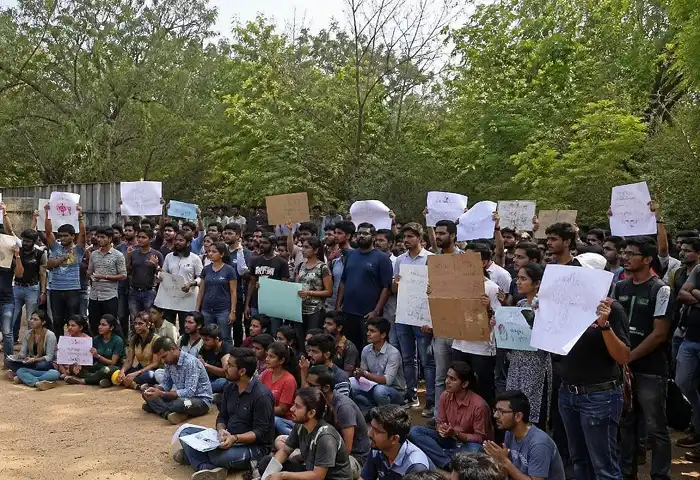
Student protests at the University of Hyderabad kept Hyderabad forest news in national conversation for weeks. Students camped near the cleared site, documented conditions on the ground, and organized demonstrations that drew television coverage across India.
Environmental groups supplied the legal petitions and photographic evidence courts used. KT Rama Rao of the Bharat Rashtra Samithi described the clearing as “brazen green murder” on social media, reaching millions of followers. Union Environment Minister Bhupendra Yadav sent a formal notice to the Telangana government demanding a factual report.
The Environment Minister stated in Rajya Sabha: “The state government felled more than 400 trees. Wild species like peacock are driven out and you can see that in videos and photos. We have sent a notice to the Chief Secretary and sought a factual report.” India TV News
Civil society pressure was the direct trigger for judicial speed. The Supreme Court moved within hours of petitions being filed.
Current Status of Hyderabad Forest News: August 2025
On August 13, 2025, the Telangana government assured the Supreme Court it is preparing a holistic development plan for the Kancha Gachibowli area, balancing environmental and wildlife interests with development objectives. All tree-cutting has stopped in compliance with court directions. Down To Earth
The Supreme Court mandated Telangana to submit a comprehensive restoration plan within six weeks. The court stated it is not opposed to development but emphasized that development must be sustainable, with appropriate mitigation and compensatory measures for the environment and wildlife. Down To Earth
The restoration plan remains under court supervision. What it contains will determine whether Kancha Gachibowli sees any meaningful ecological recovery.
You can follow related Telangana technology and infrastructure updates to understand the development pressures driving decisions like this.
Three Fixes That Would Prevent the Next Hyderabad Forest Crisis
Close the revenue land loophole. Classifying ecologically functional forest as revenue land to skip Forest Conservation Act procedures is a national problem. A criteria-based definition of forest land, grounded in ecology not administrative category, would stop this at the source.
Require EIAs before any clearance. No Environmental Impact Assessment was done before Kancha Gachibowli was cleared. This is not optional paperwork. Without it, no decision-maker is forced to account for what the clearing actually destroys.
Complete expert surveys before development begins. The Telangana expert committee formed on March 15, 2025, had just two weeks before bulldozers arrived. The Supreme Court’s own precedents require surveys first. That rule needs teeth.
Cities like Singapore and Melbourne show that urban growth and forest protection are compatible. Both integrate green corridors and tree management into city planning from the start, not as an afterthought after protests erupt.
Hyderabad can do the same. The city needs proactive green zoning that identifies ecologically valuable land and locks it in before developers arrive, not after.
Conclusion
Hyderabad forest news in 2025 tells a straightforward story: a government cleared a forest overnight to build an IT park, courts stopped it, and now a restoration plan is being written under judicial supervision. What it takes longer to explain is why this keeps happening and what it costs.
Kancha Gachibowli cooled neighborhoods, recharged water, and housed wildlife. That is gone now. Courts can halt bulldozers. They cannot restore a forest that took decades to grow.
The Telangana government’s restoration plan, due under Supreme Court supervision, will show whether accountability in this case goes beyond a temporary pause. Watch the Hyderabad forest news over the coming months. The outcome here sets a precedent for every urban forest in India facing the same pressure.